Showing posts with label miracles. Show all posts

Monday, April 29, 2013

Luke 14:1-6

A literal cow in a literal well
possibly not the Sabbath
One Sabbath, when Jesus went to eat in the house of a prominent Pharisee, he was being carefully watched. There in front of him was a man suffering from abnormal swelling of his body. Jesus asked the Pharisees and experts in the law, “Is it lawful to heal on the Sabbath or not?” But they remained silent. So taking hold of the man, he healed him and sent him on his way.

Then he asked them, “If one of you has a child or an ox that falls into a well on the Sabbath day, will you not immediately pull it out?” And they could make no reply to this.


After a morning of synagogue worship, one of the prominent Pharisees invites Jesus to dinner. This is interesting, because if the Pharisees thought Jesus was from Satan, this would make Jesus ultimately unclean - thereby defiling the Pharisee's house. Even more suspicious is the placement of a man with dropsy right in front of Jesus. Dropsy is what we call today edema - swelling of bodily tissues. It can indicate failure of the liver, kidney, or heart as the body is unable to detoxify and more fluid correctly from the body. In this time period, illness was seen as judgment for sin, and dropsy was believed to be the result of sexual sin. I doubt this man was invited over because he was a close family friend. No, the Pharisees invite the "unclean" Jesus and the "unclean" man in order to set Jesus up.

They keep fighting with Jesus over the Sabbath. Jesus goes around straightening backs, healing the blind, restoring withered hands, allowing his disciples to pick heads of grain on the Sabbath... the list goes on and on, and everything Jesus did is not even recorded. This is proof enough for the Pharisees. "He broke the Sabbath again! See, he is NOT from God!"

Jesus asks the Pharisees and law experts if it is lawful to heal on the Sabbath. Actually this is a trick question. Nowhere in the Old Testament was healing on the Sabbath prohibited. But in order to avoid breaking one of the Old Testament laws, over time the Pharisees had added additional laws to each law to ensure they did not sin. One of their added rules was that you could only be cured on the Sabbath if you would definitely die otherwise. If this was not the case, you should wait until the next day for treatment.

When no one answers Jesus, he grabs the man and heals him. Instantly the swelling disappears, skin tightens, organs begin functioning, and his joints freely move as he rushes home to show his family. You would think people would respond with, "WOW!!" Instead they glare and seethe at Jesus' behavior and lack of cultural sensitivity.

Calling attention to their hypocrisy, Jesus asks them, "If your animal or child fell into a well on the Sabbath, would you not pull it out? I doubt you would say, 'Sorry Joshua Jr., you'll have to try to tread water until tomorrow. Try to stay warm.'" They cannot reply. Of course they would deal with that situation. They used their man-made lists and regulations to pick and choose what was work and what was not. They walked closely along the lines drawn by their leaders rather than following Micah 6:8, "He has shown you, O man, what is good. And what does the LORD require of you? To act justly and to love mercy and to walk humbly with your God."

In the presence of the light of the world, most of the religious people chose to walk in darkness. It was a darkness of their own choosing, bound tightly by their religion and cultural upbringing. The chains of their religion kept them from reaching the kingdom of God. Many today bind themselves with the same chains. They keep certain rules or try to be "good people" believing that if one's good deeds outweigh the bad, heaven is waiting. One common thought is that it does not matter what you believe, as long as you believe it passionately. But Jesus taught, "I am the way and the truth and the life. No one comes to the Father except through me." There are many paths, but most lead to destruction. No matter how well you run a race, if you are on the wrong trail you will not win the prize.

Even those of us who are truly Christians must guard ourselves from religiosity. There are some tenets that we must all believe: "There is one body and one Spirit—just as you were called to the one hope that belongs to your call— one Lord, one faith, one baptism, one God and Father of all, who is over all and through all and in all" (Eph. 4:4-6). But often much of what we consider Christianity is likely just part of our culture and upbringing. Guard yourself against placing tradition on the same level as God's Word.


On one occasion an expert in the law stood up to test Jesus. "Teacher," he asked, "what must I do to inherit eternal life?" "What is written in the Law?" he replied. "How do you read it?" The man answered, "'You must love the LORD your God with all your heart, all your soul, all your strength, and all your mind.' And, 'Love your neighbor as yourself.'""You have answered correctly," Jesus replied. "Do this and you will live."  Luke 10:25-28

Tuesday, March 26, 2013

Luke 9:10-20

On their return the apostles told him all that they had done. And he took them and withdrew apart to a town called Bethsaida. When the crowds learned it, they followed him, and he welcomed them and spoke to them of the kingdom of God and cured those who had need of healing. Now the day began to wear away, and the twelve came and said to him, “Send the crowd away to go into the surrounding villages and countryside to find lodging and get provisions, for we are here in a desolate place.” But he said to them, “You give them something to eat.” They said, “We have no more than five loaves and two fish—unless we are to go and buy food for all these people.” For there were about five thousand men. And he said to his disciples, “Have them sit down in groups of about fifty each.” And they did so, and had them all sit down. And taking the five loaves and the two fish, he looked up to heaven and said a blessing over them. Then he broke the loaves and gave them to the disciples to set before the crowd. And they all ate and were satisfied. And what was left over was picked up, twelve baskets of broken pieces.

Now it happened that as he was praying alone, the disciples were with him. And he asked them, “Who do the crowds say that I am?” And they answered, “John the Baptist. But others say, Elijah, and others, that one of the prophets of old has risen.” Then he said to them, “But who do you say that I am?” And Peter answered, “The Christ of God.”


Can you imagine the excitement as the apostles returned and told Jesus "all they had done"? Their words must have tumbled all over each other. "Jesus! I spoke to a demon and it fled a young boy!" "Jesus! We healed four lepers outside the village, and their skin was instantly clean and restored!" "Jesus! Almost an entire village believed in the gospel!" "Jesus! We were driven from a village in a hail of rocks for blasphemy!"  Multiple books could be written on this conversation alone. He and his disciples tried to slip away for a time of prayer, meditation, and teaching following all that had occurred with his disciples and the death of John the Baptist.

But the crowds would not give Jesus and his disciples peace. As a mother of small children, I know how it feels to want a moment alone and not be able to find it. Jesus experienced this to a much greater degree. But instead of sneaking away in the middle of the night or barricading himself away from the crowds, he looked on them and had compassion. They looked like a flock of sheep without a shepherd. So he began the endless task of healing and preaching the good news.

The twelve wanted to send the crowds away for their evening meal and lodging. We know from John's account that Jesus asked Phillip, "Where shall we buy bread for these people to eat?" Phillip was from the area and familiar with nearby villages. But Jesus was also testing his disciples. Phillip answered him, "Eight months' wages would not buy enough bread for each one to have a bite!" Another of his disciples, Andrew, spoke up, "Here is a boy with five small barley loaves and two small fish, but how far will they go among so many?" The crowd consists of 5,000 men, plus women and children. The size of the crowd is amazing in light of the fact that the neighboring towns of Capernaum and Bethsaida probably had a population of only 2,000 to 3,000 each. Perhaps some had followed the disciples back to Jesus, and we know people were flocking from all over to seek healing. Philip tells us how overwhelming the problem is, and Andrew tells us how hopeless and how meager their resources are. Can you identify with that feeling?

We all know what happened next. Jesus took the meager fare, blessed it, and began to break it. Pieces of bread and fish continued to miraculously appear. Some today try to explain away the miracle by saying the crowd saw the boy sharing and began to share among themselves. But according to Mark 6:43 all ate and were satisfied. Bread was regarded by Jews as a gift from God, and it was required that scraps that fell on the ground during a meal be picked up. So the disciples gathered 12 baskets full of leftovers! No, this was no mere spreading of goodwill. This was a sign that pointed all who truly looked to the Son of Man and the food of eternal life that he gives.

When the people saw the sign that he had done, they said, “This is indeed the Prophet who is to come into the world!” Perceiving then that they were about to come and take him by force to make him king, Jesus withdrew again to the mountain by himself (John 6:14-15). Jesus continued to reject the world's version of kingship to follow his Father's will. Jesus had to escape and avoid His persecutors. But even worse, Jesus even had to escape followers who didn’t clearly understand his ministry.

After this Jesus and his disciples have some quiet time for prayer and reflection. Everyone had an opinion about Jesus. He evoked both admiration and spite - loved by the poor, feared and hated by many political and religious leaders. He was alternatively called from God and from Satan. When he asks the disciples who the crowds think he is, they respond with many options. But when he asks who they think he is, Peter responds with his great confession. Jesus is no mere prophet, he is the Christ, the Son of the living God.

Who do you say Jesus is? He is more than an historical figure, a good teacher from one of many religious texts. He is more than a prophet of Judaism. He is the Christ come to save us all from sin and from ourselves. He desires to take the meager broken pieces you have to bring and transform your life.


Simon Peter answered Him, “Lord, to whom shall we go? You have words of eternal life. We have believed and have come to know that You are the Holy One of God.”  - John 6:68-69

Friday, March 8, 2013

Luke 8:40-56

And as Jesus returned, the people welcomed Him, for they had all been waiting for Him. Then a man named Jairus, a synagogue leader, came and fell at Jesus’ feet, pleading with him to come to his house because his only daughter, a girl of about twelve, was dying.

As Jesus was on his way, the crowds almost crushed him. And a woman was there who had been subject to bleeding for twelve years, but no one could heal her. She came up behind him and touched the fringe of his cloak, and immediately her bleeding stopped.

And Jesus said, “Who is the one who touched Me?” And while they were all denying it, Peter said, “Master, the people are crowding and pressing in on You.” But Jesus said, “Someone did touch Me, for I was aware that power had gone out of Me.” When the woman saw that she had not escaped notice, she came trembling and fell down before Him, and declared in the presence of all the people the reason why she had touched Him, and how she had been immediately healed. And He said to her, “Daughter, your faith has made you well; go in peace.”

While He was still speaking, someone came from the house of the synagogue official, saying, “Your daughter has died; do not trouble the Teacher anymore.” But when Jesus heard this, He answered him, “Do not be afraid any longer; only believe, and she will be made well.”

When he arrived at the house of Jairus, he did not let anyone go in with him except Peter, John and James, and the child’s father and mother. Meanwhile, all the people were wailing and mourning for her. “Stop wailing,” Jesus said. “She is not dead but asleep.”

And they began laughing at Him, knowing that she had died. He, however, took her by the hand and called, saying, “Child, arise!” And her spirit returned, and she got up immediately; and He gave orders for something to be given her to eat. Her parents were amazed; but He instructed them to tell no one what had happened.


And by "welcomed" Luke means "mobbed". Only some of the followers of Jesus had formed a flotilla to the not so restful Gadarene pit stop. Many others anxiously awaited his return. "More healing! More miracles! Save us! Look at me!" The throngs pressed so close they almost crushed him.

Perhaps because of his status as a synagogue leader, Jarius makes it to Jesus. He falls at his feet in humility and respect, begging Jesus to save his dying daughter. As Jesus goes with him, an unknown woman, unclean and untouchable for twelve years, presses through the jostling crowd. Who knows how many times she had tried to reach Jesus before. She knew this was her only hope. Reaching out and touching the fringe of his garment, she is instantly healed! But Jesus feels the power leave him and asks who has touched him. Peter is taken aback. Everyone was touching everyone as they pushed through the thick mass of people. Slinking away back through the crowds was no longer an option. Shaking all over and fearing rebuke, she falls at his feet at tells all.

Now of course Jesus knew what had happened, so why not just keep walking? Because the woman was not truly made whole when her disease was cured. The words of affirmation from Jesus healed her life. As she touched the fringe of his garment, now his words touched the fringe of her soul, reaching through the clouds of desperation and self doubt and allowing her to truly go in peace.

Just then Jairus' world is shattered with the news that his daughter has died. He is told to bother Jesus no longer. But Jesus turns his eyes from the woman to look into Jairus' eyes. "Do not be afraid. Everything they are telling you is wrong. Your daughter will be made well." The wailing crowds laugh at Jesus' assertion that the girl is sleeping. They know the difference between the sleeping and the dead. Nevertheless a few disciples and the girl's parents quietly enter the house and witness a great miracle! Do you imagine the parents followed Jesus' instructions to tell no one?

Both Jairus and the woman exhibit a faith that would not give up. Despite spending all she had on doctors, being barred from Temple worship as unclean for 12 years, and likely being ostracized by the community, the woman desperately sought Jesus. The crowd could not stop her. Her fear of rejection could not stop her. She saw the source of life and would not stop until she touched it. Jairus had faith to ask Jesus to heal his daughter. But he and his wife showed extreme faith in continuing to trust Jesus when all else was stacked against them. The neighbors and professional mourners outside, wailing with ashes on their heads, would surely tell everyone what happened. Jairus had a choice: follow the members of the community in which he had such high standing or risk their mockery and loss of trust by relying on Jesus. Thankfully Jairus chose the latter.

May we exhibit the same faith. May we believe that one touch from Jesus can heal physically, emotionally, and most importantly spiritually. May we trust his words no matter what the world or even our closest friends assert to be true!


Thursday, March 7, 2013

Luke 8:26-39

Then they sailed to the country of the Gerasenes, which is opposite Galilee. When Jesus had stepped out on land, there met him a man from the city who had demons. For a long time he had worn no clothes, and he had not lived in a house but among the tombs. When he saw Jesus, he cried out and fell down before him and said with a loud voice, “What have you to do with me, Jesus, Son of the Most High God? I beg you, do not torment me.” For he had commanded the unclean spirit to come out of the man. (For many a time it had seized him. He was kept under guard and bound with chains and shackles, but he would break the bonds and be driven by the demon into the desert.) Jesus then asked him, “What is your name?” And he said, “Legion,” for many demons had entered him. And they begged him not to command them to depart into the abyss. Now a large herd of pigs was feeding there on the hillside, and they begged him to let them enter these. So he gave them permission. Then the demons came out of the man and entered the pigs, and the herd rushed down the steep bank into the lake and drowned.

When the herdsmen saw what had happened, they fled and told it in the city and in the country. Then people went out to see what had happened, and they came to Jesus and found the man from whom the demons had gone, sitting at the feet of Jesus, clothed and in his right mind, and they were afraid.  And those who had seen it told them how the demon-possessed man had been healed. Then all the people of the surrounding country of the Gerasenes asked him to depart from them, for they were seized with great fear. So he got into the boat and returned. The man from whom the demons had gone begged that he might be with him, but Jesus sent him away, saying, “Return to your home, and declare how much God has done for you.” And he went away, proclaiming throughout the whole city how much Jesus had done for him.


After the calming of the storm, the stunned disciples land on the other side of the Galilee. Several boats of people step off into the land of the Gerasenes. The people here were culturally more Hellenistic than Semitic, accounting for the presence of pig farmers. Needless to say, these folks were not Orthodox Jews. Perhaps this will be a place Jesus and his small crowd of disciples can find respite from the throngs.

Up on the hill were two demon possessed men who lived among the tombs. If the one in this story lived today, he would be jailed or institutionalized and heavily sedated with drugs. He was dangerous to himself and society and had been banished from civilization. The locals had tried binding him with heavy chains, but in fury he ripped them apart. No guard could keep him controlled. Imagine this man: naked, skin marred from the beating sun in the day and exposure to cold at night, cuts and scars from self-mutilation. When anyone neared the tombs he would run down to attack them. The townspeople knew to steer clear.

As Jesus and his crowd entered this man's territory, he flew down the hill towards them. Perhaps at first the demons did not recognize this man who looked like any other. At the command of Jesus to leave the man the demons threw their host to the ground, not in worship but in fear. Controlling his voice, they ask "What have you to do with me, Jesus, Son of the Most High God? I beg you, do not torment me." We know from other scriptures that some demons are bound for now in the Abyss and some are allowed to roam the earth, destroying whom they can. These demons know Jesus has the power to bind them or destroy them. No one outside Jesus and his apostles have had this power.

The demons beg to be sent into a herd of pigs. For Gentiles the herd of pigs would be a standard way to make a living. For Jewish observers they would be a source of revulsion. (I would be thinking Carolina barbecue myself!) For whatever reason, Jesus let the demons have their choice. Good news for the man, bad news for the pigs and the farmers. Possession stirred the pigs into a panicking mob, rushing over the cliffs and into the sea to drown.

The herdsmen immediately run into town to alert the townspeople. They come out amazed that the insane dangerous man is now sitting clothed, calmly sitting at the feet of a Jewish teacher. Whereas other regions mobbed Jesus for more miracles, here they were afraid of this sorcery and more concerned about the loss of monetary gain. The cured man had a different attitude. He begged Jesus to be allowed to come along as a disciple. But Jesus sent him home to be a witness to the fearful townspeople who had expelled Jesus from their region.

It is said that the greatest lie of Satan is that he has convinced the world that he either does not exist or that he has unimaginable power. We cannot understand everything about the unseen spirits, but any of our knowledge should come from the Bible, not from Hollywood or people's personal accounts.

Demons around Jesus could not help but reveal themselves. But as a rule they are much more subtle. They are still at work today. Although we may not pass our children through the fires of Baal, we surgically abort about 3,288 babies per day in America (not to mention the morning after pill). Although many who support abortion want them to be "safe and rare", there are those who actually celebrate it. We emotionally, physically, and sexually abuse children. We rape and kill. Rarely is any of this attributed to demonic activity. We talk about depression, mental illness, or personal choice. While these things are real, we should focus on putting on the armor of God against spiritual darkness. Evil forces want nothing more than to keep you from believing on Christ, and if you do believe to make you turn back or be as ineffective of a Christan as possible. As 1 Peter 5:8 warns, "Be self-controlled and alert. Your enemy the devil prowls around like a roaring lion looking for someone to devour." He wants you to be miserable, overwhelmed, and self doubting. He wants you to hold bitterness in your heart. Through the power of God you can overcome him. As James 4:8 teaches, "Submit yourselves therefore to God. Resist the devil, and he will flee from you."

On a positive note, we see from this story that God can use anyone as a missionary. This man once possessed could now enter a town where Jesus himself was unwelcome and share the gospel with his kinsmen. Jesus can transform any life. When everything else has failed, the power of God can turn your life around for his glory. That doesn't mean you will have an easy life. I doubt the former demoniac had a rousing welcome home party restoring him to wealth and prosperity. He was likely treated with suspicion at least for a time. Nevertheless he gladly walked the road set before him by Christ.


First, then, here is what these children are to tell. It is to be a story of personal experience. "Go home to thy friends and tell them how great things the Lord has done for thee, and hath compassion on thee." Not what you have believed, but what you have felt; what you really know to be your own; not what great things you have read, but what great things the Lord has done for you; not alone what you have seen done in the great congregation, and how great sinners have turned to God, but what the Lord has done for you. And mark this: There is never a more interesting story than that which a man tells about himself.  - C.H. Spurgeon 

Wednesday, March 6, 2013

Luke 8:19-25

And His mother and brothers came to Him, and they were unable to get to Him because of the crowd. And it was reported to Him, “Your mother and Your brothers are standing outside, wishing to see You.” But He answered and said to them, “My mother and My brothers are these who hear the word of God and do it.”


Now on one of those days Jesus and His disciples got into a boat, and He said to them, “Let us go over to the other side of the lake.” So they launched out. But as they were sailing along He fell asleep; and a fierce gale of wind descended on the lake, and they began to be swamped and to be in danger. They came to Jesus and woke Him up, saying, “Master, Master, we are perishing!” And He got up and rebuked the wind and the surging waves, and they stopped, and it became calm. And He said to them, “Where is your faith?” They were fearful and amazed, saying to one another, “Who then is this, that He commands even the winds and the water, and they obey Him?”


Jesus' own family did not follow him constantly like his disciples. We know his mother knew who he was, but his brothers did not believe at this time. After the resurrection, James became a church leader and wrote the book bearing his name. Historians assume Joseph was dead by the time of Jesus' crucifixion. But his family came to check in on him and found crowds so dense that even their credentials could not grant them access.

When the information was passed to Jesus, his response was shocking. But his teaching had been that blood relationships did not matter, listening to and applying the Word of God did. The ties that bind true believers are stronger than any DNA or childhood memories.

With the crowds constantly pressing around him, Jesus came up with creative ways to find rest. Several of his disciples were seasoned fishermen who grew up sailing the Sea of Galilee, likely the setting for our story. Exhausted, Jesus fell asleep in the gently rocking boat as they sailed to the other side.

Because the Sea of Galilee is below sea level and is surrounded by mountains, it is susceptible to sudden storms. It is a relatively small body of water (thirteen miles long, seven miles wide); but it is 150 feet deep, and the shoreline is 680 feet below sea level. Winds sweeping across the land come up and over the mountains, creating downdrafts over the lake. Combined with a thunderstorm that appears suddenly over the surrounding mountains the water stirs into violent twenty-foot waves. The sea can be calm one minute and violent the next.

This sudden storm carries such severity that even the seasoned fishermen are terrified. After all, they likely knew men who had perished in similar storms. The boat becomes swamped with water and is close to capsizing. Fearing death, they shake Jesus to wake Him up. He rebukes them for their lack of faith. After all, he had told them they would be going to the other side. Shouldn't they have trusted his word that they would arrive?  He speaks a simple phrase and calms the seas. The disciples are shocked! They have seen Jesus heal disease, cast out demons, and even restore life, but they still cannot wrap their minds around the absolute power of the Christ even over nature. Surely this storm was used by God to strengthen the faith of the disciples for the storms that would rage in their future lives.

Most storms in our life come suddenly, often with a severity  that shocks us. It can seem as if God is asleep, caring not if we perish. Or we may be engulfed in a storm of sin which seemed at first a beckoning tranquil breeze. Sometimes God sends the storms to strengthen our faith or to discipline us. Whatever the cause, we cry out to God when the storm becomes something we feel we cannot handle on their own. Just as the disciples did not wake Jesus until they felt they were at the point of perishing, we often try to handle life through our own strength until things spiral out of control. Even though we have the testimony of Scripture and knowledge of how God has worked in our own and others' lives, we can doubt His purpose and plan in the midst of storms.

But even if our faith is great, Jesus may not speak the words that would calm the storms in our own lives. Remember that even in his earthly ministry he did not miraculously feed every crowd, heal every disease, cast out every demon, or turn every funeral procession into a resurrection party. Although everyone he healed had faith, not everyone with faith was healed. But even if the storms continue to rage, never doubt that he is with you in the boat! God often uses the fires of this life to refine us into the image of Christ. One of my favorite songs has the following chorus:
Sometimes He calms the storm
With a whispered peace be still
He can settle any sea
But it doesn't mean He will
Sometimes He holds us close
And lets the wind and waves go wild
Sometimes He calms the storm
And other times He calms His child

I love you, Lord, my strength.
The Lord is my rock, my fortress and my deliverer;
my God is my rock, in whom I take refuge,
my shield and the horn of my salvation, my stronghold
- Psalm 18:1-2


Tuesday, February 26, 2013

Luke 7:11-19

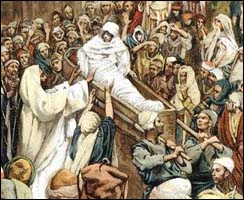
Soon afterward he went to a town called Nain, and his disciples and a great crowd went with him. As he drew near to the gate of the town, behold, a man who had died was being carried out, the only son of his mother, and she was a widow, and a considerable crowd from the town was with her. And when the Lord saw her, he had compassion on her and said to her, “Do not weep.” Then he came up and touched the bier, and the bearers stood still. And he said, “Young man, I say to you, arise.” And the dead man sat up and began to speak, and Jesus gave him to his mother. Fear seized them all, and they glorified God, saying, “A great prophet has arisen among us!” and “God has visited his people!” And this report about him spread through the whole of Judea and all the surrounding country.


Nain was a city of Galilee about six miles south of Nazareth, on the northwest slope of the Hill of Moreh. It is the same place where Gideon attacked the Midianites. Possibly Jesus and his disciples had been through before, and the townspeople surely knew of this miracle worker. Jesus is followed by a huge crowd, and as they neared the gate of the city they were met by another large crowd trying to carry a body out of the city. (I picture Black Friday crowds jostling for position here!)

The second crowd follows a wailing widow. She has lost her only son, a fate many today would consider unbearable. But as a widow in this time she could not inherit property, and anything she owned would revert to her husband's closest relative upon the death of her son. In one moment this woman had lost love, hope, and any security in her life. She certainly needed help from God.

Jesus' heart overflowed with compassion as he comforted the mother, although I have to imagine that she thought the Aramaic equivalent of "yeah right" when he instructed her not to weep. The bearers of the open coffin stood still as Jesus approached. I imagine they were waiting for some insightful teaching. No one expected what would happen next. With a command from the Son of God, the young man sits up and begins to speak! Don't you wonder what he said?

Jesus lifts the young man from his coffin and hands him to his flabbergasted mother. Both crowds are seized with awe at what has happened and begin rejoicing. They imagine Jesus to be a prophet in the style of Elijah or Elisha, missing the grander point, but they cannot help but realize that God had visited his people. Of course the Galilean grapevine lights up with the story that spreads even through Judea.

Any of us who have attended funerals can imagine how amazing it would be were the dead to rise up with a healed body and words of praise on their lips. But Jesus' miracles were not simply performed to reward faith and show his kindness. He shows his power over even death. John writes that the miracles were performed and recorded so that all who hear would believe that Jesus is the Messiah, the Son of God, and that by believing you may have life in his name (20:31). This is also a symbol of how Jesus has power over our spiritual deadness. He has the power to raise our dead spirits and breathe true life into is. As tragic as physical death can be, spiritual death is a fate far worse. This is the promise which He Himself made to us: eternal life (1 John 2:25). Those of us who have placed our trust in him have nothing to fear in life or death!


Because God’s children are human beings—made of flesh and blood—the Son also became flesh and blood. For only as a human being could he die, and only by dying could he break the power of the devil, who had the power of death. Only in this way could he set free all who have lived their lives as slaves to the fear of dying.  - Hebrews 2:14-15


Monday, February 18, 2013

Luke 6:1-11

On a Sabbath, while he was going through the grainfields, his disciples plucked and ate some heads of grain, rubbing them in their hands. But some of the Pharisees said, “Why are you doing what is not lawful to do on the Sabbath?” And Jesus answered them, “Have you not read what David did when he was hungry, he and those who were with him: how he entered the house of God and took and ate the bread of the Presence, which is not lawful for any but the priests to eat, and also gave it to those with him?” And he said to them, “The Son of Man is lord of the Sabbath.”

On another Sabbath, he entered the synagogue and was teaching, and a man was there whose right hand was withered. And the scribes and the Pharisees watched him, to see whether he would heal on the Sabbath, so that they might find a reason to accuse him. But he knew their thoughts, and he said to the man with the withered hand, “Come and stand here.” And he rose and stood there. And Jesus said to them, “I ask you, is it lawful on the Sabbath to do good or to do harm, to save life or to destroy it?” And after looking around at them all he said to him, “Stretch out your hand.” And he did so, and his hand was restored. But they were filled with fury and discussed with one another what they might do to Jesus. 


Our common response to these stories is to shake our head at those silly Pharisees and their silly rules. But I have to respect their willingness to sacrifice and their fervor to follow the laws of God. Yes, by this point in history law upon law had been added to keep people from breaking a commandment, and many attributed the same weight to the man-made laws as to God's Law. But I am sure many of the Pharisees and other Jews did this in an attempt to truly please God, not simply to retain power or to catch this new prophet in a sin.

Ever on the move from the large crowds, the disciples were walking through a field one Sabbath. Possibly unconsciously they pick off a few heads of grain to munch. (Let's be honest; we all know what that's like!) The Pharisees left no room for such an action. Clearly Jesus' disciples were in violation of the law for harvesting and threshing grain! They were completely serious - one didn't even spit on the ground on the Sabbath in case it would make a furrow for something to grow! Jesus takes responsibility for the actions of the disciples by citing the time when King David fed his hungry troops with consecrated bread meant only for consecrated priests from the tribe of Levi. As King David put the physical needs of his soldiers above ritual law, so Jesus put the needs of his disciple over the man-made laws protecting the Sabbath. Jesus' last statement would have filled them with anger as he claimed to be Messianic and the Lord of the Sabbath.

Jesus did follow many of the religious customs, continuing to worship in the local synagogue each Sabbath. As usual, he was chosen to speak. Seeing a man with a withered hand close to Jesus, his opposition watched closely to see if he would follow Sabbath rules of rest or continue his mission to "release the oppressed". Jesus not only healed the man he first provided one of his potent quotables, “I ask you, is it lawful on the Sabbath to do good or to do harm, to save life or to destroy it?” Of course they have no good way to answer this, which likely adds to their fury.

So what can we take from this? How should we honor the Sabbath without becoming legalistic? Commandment number four still applies to believers today. When my parents were growing up there were "blue laws" that kept businesses closed on Sundays. Most people attended church and spent time with families on Sundays. The only work done was related to getting Sunday dinner on the table. Today Sundays are as busy as any other day, and sometimes even church activities can shove rest and worship out of our spiritual lives. Football and other sports on Sundays can crowd out our focus on God as well.

Jesus' example was to observe the Sabbath as a day of rest and worship in the synagogues without the minute restrictions placed on the observance of the law by the Pharisees. The focus of the Sabbath should be first on honoring and worshiping God as we follow his example of rest on the seventh day. The second should be on loving our neighbor as ourselves. Taking one day out of the week to focus on these two concepts and allow ourselves time to physically and mentally rest would affect our entire week in a positive manner. It is up to each of us to pray for discernment about how our Sabbath should be spent. This should be done on a regular basis to avoid keeping the letter of the law and completely missing the true spirit of it as the Pharisees in this story.


“Teacher, which is the great commandment in the Law?”  And he said to him, “You shall love the Lord your God with all your heart and with all your soul and with all your mind. This is the great and first commandment. And a second is like it: You shall love your neighbor as yourself. On these two commandments depend all the Law and the Prophets.” 
- Matthew 22:36-40