Showing posts with label John the Baptist. Show all posts

Wednesday, February 27, 2013

Luke 7:18-35

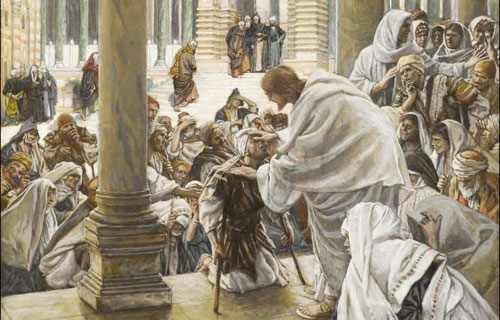
The disciples of John reported all these things to him. And John, calling two of his disciples to him, sent them to the Lord, saying, “Are you the one who is to come, or shall we look for another?” And when the men had come to him, they said, “John the Baptist has sent us to you, saying, ‘Are you the one who is to come, or shall we look for another?’”  In that hour he healed many people of diseases and plagues and evil spirits, and on many who were blind he bestowed sight. And he answered them, “Go and tell John what you have seen and heard: the blind receive their sight, the lame walk, lepers are cleansed, and the deaf hear, the dead are raised up, the poor have good news preached to them. And blessed is the one who is not offended by me.”

When John's messengers had gone, Jesus began to speak to the crowds concerning John: “What did you go out into the wilderness to see? A reed shaken by the wind? What then did you go out to see? A man dressed in soft clothing? Behold, those who are dressed in splendid clothing and live in luxury are in kings' courts. What then did you go out to see? A prophet? Yes, I tell you, and more than a prophet. This is he of whom it is written,

      “‘Behold, I send my messenger before your face,
         who will prepare your way before you.’

I tell you, among those born of women none is greater than John. Yet the one who is least in the kingdom of God is greater than he.” (When all the people heard this, and the tax collectors too, they declared God just, having been baptized with the baptism of John, but the Pharisees and the lawyers rejected the purpose of God for themselves, not having been baptized by him.)

“To what then shall I compare the people of this generation, and what are they like? They are like children sitting in the marketplace and calling to one another,

      “‘We played the flute for you, and you did not dance;
         we sang a dirge, and you did not weep.’

For John the Baptist has come eating no bread and drinking no wine, and you say, ‘He has a demon.’ The Son of Man has come eating and drinking, and you say, ‘Look at him! A glutton and a drunkard, a friend of tax collectors and sinners!’ Yet wisdom is justified by all her children.”

You can hardly blame John. After a lifetime of devotion to God, he was arrested for his righteous judgment of Herod. Things had not worked out the way he imagined. After pointing out Jesus as the Messiah no kingdom had come for the Jews. Nothing was changing... or so it seemed. He sent his disciples to ask Jesus point blank if he was the Messiah. Perhaps John feared his entire life's work had been in vain.

Rather than giving them an answer that could be used against him either way by his opponents, Jesus spends an hour healing diseases, casting out demons, restoring sight to the blind, and preaching the good news to the poor - clear fulfillment of Messianic prophecies. John would understand the report loud and clear. Jesus might not be exactly the Messiah he had imagined, but the kingdom of God was at hand nevertheless.

Jesus commends John to the level of the greatest prophet ever, in fact the one who would come in the spirit of Elijah to prepare the way for the Christ. But the others in the generation who reject John and Jesus are compared to pouting sulking children who refuse to dance at times of joy or cry at times of mourning. They simply miss the point and the celebration. He calls out the Pharisees on their inconsistencies and hypocrisy. They judged John for his extreme fasting - attributing his unusual behavior to demonic possession. When Jesus came feasting they judged him as well. The Message puts it this way: "John the Baptist came fasting and you called him crazy. The Son of Man came feasting and you called him a lush. Opinion polls don't account for much, do they?" Neither man played by the Pharisees' rules, so they would rather take their ball and go home. Some people will just never be happy.

Are there inconsistencies in our words and actions when it comes to our faith? Do we judge people rather than carefully seeking the truth of a situation? We must be vigilant to guard against falling into ruts in our beliefs rather than searching Scripture and seeking the leading of the Holy Spirit. True wisdom will be proved by the fruit borne by following it.

The fear of the LORD is the beginning of knowledge, but fools despise wisdom and discipline.
 - Proverbs 1:7

Friday, February 1, 2013

Luke 3:19-38

21 Now when all the people were baptized, Jesus was also baptized, and while He was praying, heaven was opened, 22 and the Holy Spirit descended upon Him in bodily form like a dove, and a voice came out of heaven, “You are My beloved Son, in You I am well-pleased.” (full text here)

The act of accusing Herod of an unlawful marriage and other sins would eventually lead to John's arrest and beheading. Nevertheless he was willing to risk his life to proclaim the good news and do God's will in calling people to repentance.

Much ado is made of Jesus' baptism. For example, why would he need to be baptized if he were not in need of repentance? Was this a symbol of him entering the royal priesthood? Was he being baptized for the sins of all people or as a model for all of us to follow? All of these ideas are conjecture that must be read into the text. Jesus simply told John that he must baptized "to fulfill all righteousness". John certainly did not feel qualified for such a task, but he did as the Lord commanded. And the Trinity danced in the waters of the Jordan - the voice of the Father expressing his pleasure, the Holy Spirit descending like a dove, and Jesus beginning his ministry in humility as an example to us all.

Luke the historian gives us the genealogy of Jesus all the way back to Adam and God himself. Perhaps tracing back to Adam  implies that through Jesus salvation is offered to all mankind. Several of the names jump out as men of the Old Testament - King David, Boaz, Abraham, Noah, and Adam among others. Reading these names brings to mind stories of mighty feats done for God, redemption, a chosen people, and even how God uses flawed people to carry out his purposes.

Although the men are mentioned, we know from Old Testament history that some interesting woman are on this family tree. It contains a woman (Tamar) who dressed as a prostitute to convince her father in law to fulfill his duty and produce an heir for her dead husband, an adulteress (Bathsheba), a foreign prostitute (Rahab) who is eventually mentioned in the "Hall of Faith" in Hebrews 11, and a Gentile Moabitess who left her family to care for her mother in law in a land she did not know (Naomi).

The names we know from the historical record give depth to the our knowledge of the heritage given to Jesus from the human side of his being. But I always wonder about those we know nothing about - Melchi, the son of Addi and the like. Were they righteous? Did they raise their children to fear the Lord, or were some generations lost to the paganism of the surrounding culture? Regardless it is clear that by the time of Jesus' birth, Mary and Joseph families were upright followers of the Law and loved God with their hearts souls and minds. All the times we skip the biblical genealogies or rush through them in our yearly Bible readings we are missing an opportunity to ponder how the generations fly by, leaving only a legacy that either leads those who come after us to repentance or draws them away.

What legacy will you leave today?


But from everlasting to everlasting the LORD's love is with those who fear him, and his righteousness with their children's children - with those who keep his covenant and remember to obey his precepts. - Psalm 103:17-18

Thursday, January 31, 2013

Luke 3:15-18

Now while the people were in a state of expectation and all were wondering in their hearts about John, as to whether he was the Christ, John answered and said to them all, “As for me, I baptize you with water; but One is coming who is mightier than I, and I am not fit to untie the thong of His sandals; He will baptize you with the Holy Spirit and fire. His winnowing fork is in His hand to thoroughly clear His threshing floor, and to gather the wheat into His barn; but He will burn up the chaff with unquenchable fire.”


Despite his fiery preaching style, John displays refreshing humility. Many in the community were desperately awaiting the Messiah, and the crowd was abuzz with the hypothesis that John was he. What an opportunity to attract a large following and start a movement! He could have even tried to justify his actions since being considered the Messiah could gain him a larger audience to preach his message of repentance. At the least he could have offered a shrug and remained mysterious.

But he doesn't. Not only does John put the Messianic rumors to rest, he places himself in one of the lowest categories possible. Only a slave would have the job of untying Jewish sandal caked with dust and sweet. National pride prevented a Hebrew from ever being required to do this for another Hebrew. John maintains that he is not even worthy of being a slave of Jesus.

Not only was Jesus' character superior to John, so was his mission. John performed a baptism of water and repentance; Jesus would baptize with the Holy Spirit and fire. Fire has the unique property of bringing both destruction and life. This fire would burn away the impurities of unbelievers while leaving his followers purged and perfected.

A winnowing fork is used to separate the desirable wheat from the undesirable chaff after a harvest. The wheat is the solid, good part used for food. The chaff provides protection for the wheat berries while growing but after harvest is the fluffy "bad part" most easily disposed of by burning. Before the winnowing could be done, the wheat would be thoroughly threshed - beaten to separate the wheat and the chaff. Throw the threshed wheat in the air, and the heavier wheat berries fall straight down, while the chaff blows away with the wind.

Jesus' coming would divide people into two camps - those who accepted him and were purified and those who were ultimately destroyed. But none of us are fully "wheat" this side of heaven. The trials and circumstances of life are used by God to "thresh" the chaff from our lives. In the midst of tribulation our true character is often revealed. Some are solid in their faith and come through purified; others float away and miss their chance at purification. We all have elements of the old, sinful man that cling to us. At times we may have these traits for protection, and at times they may seem "engrained" parts of our personality (groan - pun intended).

What "chaff" in your life needs to be threshed and burned?


The parabolic statement about wheat and chaff reminds us not only that the community is mixed but also that each of us have our own good and bad elements. There is for each of us chaff that needs to be blown away and burned. There is a separation here of good and bad, useful and useless; but it is not like the difference between apples and oranges. Each of us individually is wheat and chaff.  - The Very Rev. Dennis J.J. Schmidt

Wednesday, January 30, 2013

Luke 3:10-14

And the crowds asked him, “What then shall we do?” And he answered them, “Whoever has two tunics is to share with him who has none, and whoever has food is to do likewise.” Tax collectors also came to be baptized and said to him, “Teacher, what shall we do?” And he said to them, “Collect no more than you are authorized to do.” Soldiers also asked him, “And we, what shall we do?” And he said to them, “Do not extort money from anyone by threats or by false accusation, and be content with your wages.”


I guess the long walk and search to find John in the wilderness may have been a factor, but it is a little surprising that after the tongue lashing given to some who seemed very righteous that the crowds still listened to John. They must have sensed the Spirit of God on him and recognized great wisdom in the words he spoke. Imagine the panic of many when John said that even those with all the appearance of outward righteousness were simply a brood of vipers and a tree about to be chopped down by God!

Instead of revolting against John's teaching, the crowd asks what could be done to achieve righteousness. Not one to mince words, John responded with difficult tasks that still apply today. Although faith in Christ is the only thing that saves, there are specific challenges in this passage that lead us into righteousness and conform us into a closer mirror of the image of God.

“Whoever has two tunics is to share with him who has none, and whoever has food is to do likewise.” This one seems easily translatable to today's society, but it is far more difficult to carry out. The Greek for tunic is chiton, a long garment worn under the cloak next to the skin. But I don't think we can try to justify ourselves and give away all but one of our slips. If there are people to whom we can reach out that do not have clothes and we have overflowing closets, we are not righteous. At our house the worn out, outgrown, or out of style clothes are the ones sent to donation. That is cleaning the house, not righteousness. And how much food is in your pantry? Do you have food that goes bad and gets thrown out while people around the world and down the street go hungry? Then you are not truly righteous. James 2:14-16 says, What good is it, my brothers and sisters, if someone claims to have faith but has no deeds? Can such faith save them? Suppose a brother or a sister is without clothes and daily food. If one of you says to them, “Go in peace; keep warm and well fed,” but does nothing about their physical needs, what good is it? I am not saying we all need to be ascetic, but I am sure that most believers could improve in this area. The fact that we will not achieve perfect righteousness in this life does not absolve us of seeking to improve. You do not have to be rich to show fruits of repentance. Just have a little extra for today and give it away.

“Collect no more than you are authorized to do.”  It is unlikely that anyone reading this is considered a national traitor working for an oppressive foreign government, but there is great spiritual truth in this verse. These Jewish tax collectors were known for charging more than the prescribed amount in order to pad their own pockets. Rather than ordering them to quit their evil jobs, John admonished them to live within their means. In our "but now, pay later", lottery playing, credit card happy world we rarely do this. Can you be happy living within your means, even carving into your income to sacrificially share with others, without looking for more monetary gain?

“Do not extort money from anyone by threats or by false accusation, and be content with your wages.” These may not have been true Romans but were probably Jews who signed up for or were conscripted by the Roman military service. Perhaps they were there to protect the tax collectors. They received small wages. Repentance for them meant being satisfied with this small paycheck rather than using their power and the threat of Rome to extort money from others. Perhaps you are in a position of authority over others; don't use your power for your own gain. And all of us are called to be satisfied with our jobs - not to complain about our work situation or be unsatisfied with our net income.

John's message still cuts to the heart of believers today, and we can all improve in righteousness in one or all of these areas.


“Then the King will say to those on His right, ‘Come, you who are blessed of My Father, inherit the kingdom prepared for you from the foundation of the world. For I was hungry, and you gave Me something to eat; I was thirsty, and you gave Me something to drink; I was a stranger, and you invited Me in;  naked, and you clothed Me; I was sick, and you visited Me; I was in prison, and you came to Me.’ Then the righteous will answer Him, ‘Lord, when did we see You hungry, and feed You, or thirsty, and give You something to drink? 38 And when did we see You a stranger, and invite You in, or naked, and clothe You? When did we see You sick, or in prison, and come to You?’ The King will answer and say to them, ‘Truly I say to you, to the extent that you did it to one of these brothers of Mine, even the least of them, you did it to Me.’  - Matthew 25:34-40

Tuesday, January 29, 2013

Luke 3:7-9

So he began saying to the crowds who were going out to be baptized by him, “You brood of vipers, who warned you to flee from the wrath to come? Therefore bear fruits in keeping with repentance, and do not begin to say to yourselves, ‘We have Abraham for our father,’ for I say to you that from these stones God is able to raise up children to Abraham. Indeed the axe is already laid at the root of the trees; so every tree that does not bear good fruit is cut down and thrown into the fire.”


John does not seem to be running a seeker friendly church here! What kind of preacher calls those who come to be baptized a brood of vipers? But John was not content to gain a large number of followers, especially those concerned only with superficial righteousness. He calls out the crowd for wanting to attain one more spiritual sticker on their chart. John's listeners needed to know and take seriously the divine judgment to come.

John warns them that if they are going to go through the ritual of baptism, they needed to be willing to live a life of true repentance. No religious designation or even being considered children of Abraham and members of the chosen nation would save them. God was working in the world to remove those claiming to bear his name who did not bear fruit and graft in those who would enter into righteousness through Christ.

Even today many take pride in religious designation. You may be certain that your denomination is better than all the others and secretly you believe that you will get some bonus "fruit points" for being a member (see Baptists in heaven joke for some levity on the subject). Perhaps you can trace your Christian lineage back decades, centuries, or even back to the apostles themselves.

None of this will save you. Only true repentance and belief in Jesus as Savior can accomplish this. And if you truly repent and truly believe on Him, your life will bear good fruits of repentance. If others cannot look at your life and see good deeds, if you are not daily crucifying the old self with its desires, if you do not look more Christlike as each year passes then you should examine your heart and mind to discern if you have truly repented and believed.


But the fruit of the Spirit is love, joy, peace, patience, kindness, goodness, faithfulness, gentleness, self-control; against such things there is no law. - Galatians 5:22-23

Monday, January 28, 2013

Luke 3:1-6

Focus verses: Luke 3:4-6
As it is written in the book of the words of Isaiah the prophet,
    “The voice of one crying in the wilderness:
    ‘Prepare the way of the Lord,
        make his paths straight.
    Every valley shall be filled,
        and every mountain and hill shall be made low,
    and the crooked shall become straight,
        and the rough places shall become level ways,
    and all flesh shall see the salvation of God.’” (full text here)

Luke again inserts historical data to give credence to his narrative as well as place John the Baptist in a specific time in history. Here's a little rundown of the men he mentions:
  • Tiberius Caesar - ruled Rome from 14-27 AD, beginning John's ministry in AD 28-29 according to Luke. He was an excellent military commander and government administrator, but eventually problems with the Senate led him to abandon Rome for the island of Capri. By the time he died, he was generally despised by the Roman people.
  • Pontius Pilate - known for going head to head on several occasions with the Jews and Samaritans over religious beliefs that conflicted with Roman practices. He was violent and ruthless in his rule.
  • Herod Antipas - son of Herod the Great. He inherited Galilee and Perea (where John ministered). He married a Nabatean princess, then divorced her to marry Herodias, his niece and the wife of his half brother. John and others verbally attacked him for this marriage, which Jewish law considered unlawful. Herod retaliated by imprisoning and ultimately beheading John. He is also the Herod involved with the trial of Jesus.
  • Herod Philip - another son of Herod the Great. (I kid you not; the Herod family tree looks like a spider web.) He also inherited land from his father but was known for justice. Like his father, he was known as a builder, creating Caesarea Philippi.
  • Lysanias tetrarch of Abilene - not much is known about this man apart from a quick reference from the Jewish historian Josephus and an inscription on a temple which refers to Lysanias establishing the street and other things.
  • Annas and Caiaphas - Jewish high priests appointed by Rome. Annas was the father in law of Caiaphas and continued to exert power even after the official title of high priest rested on Caiaphas. Caiaphas was the high priest during the ministries of John and Jesus. Caiaphas established the practice of allowing vendors to sell their wares in the courtyard of the Temple. Both men feature prominently in the plot to crucify Jesus as well as attempts to silence the apostles in the book of Acts.
Four hundred years after the prophet Malachi, John begins his ministry in the wilderness. People leave the cities in droves in order to search for John, since he did not stay in one place but moved about. John called the people to repent for their sins and be baptized, a practice not unheard of but uncommon for those of the Jewish faith. He called not for mere ritual cleansing, but purification of the deepest sins of a person's heart. John spent his ministry preparing hearts to receive the Messiah soon to come.

Luke quotes the prophet Isaiah (Is. 40:3-5) in our focus verses. This passage promised the Hebrew people deliverance from Babylonian exile through a path God would provide in the wilderness. John's listeners were promised an even greater path, salvation through repentance and belief in the Messiah. This would be a salvation provided not only for God's chosen nation, but for "all flesh". John was preparing people to humble themselves and turn from their sins in order to be prepared for the salvation that would come through Jesus.

When we seek God's direction, the Holy Spirit will reveal clearly the path we need to take toward repentance in our own lives. The path to holiness may not be easy, but it will be laid out as clearly to us as a straight path over flat terrain.


"I will lead the blind by a way they do not know, In paths they do not know I will guide them. I will make darkness into light before them and rugged places into plains. These are the things I will do, and I will not leave them undone."  - Isaiah 42:16

Friday, January 18, 2013

Luke 1:67-80

Luke 1:74-79
74 since we have been rescued
from our enemies’ clutches,
to serve Him without fear
75 in holiness and righteousness
in His presence all our days.
76 And child, you will be called
a prophet of the Most High,
for you will go before the Lord
to prepare His ways,
77 to give His people knowledge of salvation
through the forgiveness of their sins.
78 Because of our God’s merciful compassion,
the Dawn from on high will visit us
79 to shine on those who live in darkness
and the shadow of death,
to guide our feet into the way of peace. (full text here)


God must have seemed silent. Oppressed by a Roman occupation, in the midst of a culture growing more and more Hellenistic, as every Sabbath ancient scriptures were read that promised a hope and a future, many must have pondered how long it could be before God would act. Most thought a military answer would save them - a Messiah strong and mighty to save. Surely they would be saved to rule themselves, miraculously overthrowing the Romans and reestablishing the house of David.

But when the Holy Spirit rests on Zechariah, he prophesies about a much different scenario. Yes salvation was coming, but it would free God's people to serve the Lord. Rather than free to make military and financial gains, they were free to live in righteousness and holiness. The covenant of Abraham was not to overthrow enemies, but that through his descendant, Jesus, the world would be saved from the shackles of sin.

No prophet had been recorded for 400 years, but John was sent as a prophet of the most high God. He prepared the way for the Christ by brazenly calling people out for their sins and showing them tangible ways to repent. God's compassion wasn't about a comfortable life, it was about shining a light to lead us away from the path of sin that winds through the shadow of death. It was about peace, not prosperity. And today that same peace is available to us through God's merciful compassion! God may not act in the way we expect or desire, but he will always amaze us with his faithfulness and compassion when we walk his path.

Repent, for the kingdom of heaven is near.


The people walking in darkness have seen a great light; on those living in the land of the shadow of death a light has dawned.  - Isaiah 9:2

Thursday, January 17, 2013

Luke 1:57-66

Luke 1:63-64 - He asked for a writing tablet, and to everyone’s astonishment he wrote, “His name is John.” Immediately his mouth was opened and his tongue set free, and he began to speak, praising God.  (full text here)


Crowds always line up to see a new baby. In the days before mass entertainment, this may have been even more true. The community that had once whispered about what Zechariah and Elizabeth had done to merit God's disfavor now marvelled that a son had been mercifully born in their old age. After so many decades, the couple had an heir. Surely the firstborn and likely only child would be named after his father. But having many months to silently contemplate the words of the angel Gabriel, Zechariah instantly corrected his neighbors and family in obedience to the words spoken to him in the holy place of the temple.

Circumcision on the eighth day was a celebratory and holy affair - the sign of God's covenant with his people. The son had survived long enough to earn an official name and in a way his personhood. The age of the parents, the story of the angel, and even the naming of the child had tongues wagging all over the hill country. If God could move so strongly in the birth of this miracle child, surely great things were planned for his life.

The Hebrew name for John, Yôḥanan, means "Graced by Yahweh". John was graced not to serve as a priest like his father, but to survive in the wilderness bringing many to repentance and preparing the way for Jesus. Surely he grew up hearing that God had a great plan for his life. Surely his righteous parents steadfastly taught him the ways of God. And when the time came for him to fulfill his purpose he did so, even to death by beheading.

The gospel begins with ordinary people choosing to live lives of obedience to the father. What must happen before we are willing to believe and become what he would have us be? Need he strike us deaf and dumb for nine months like Zechariah or send us into nine months of seclusion like Elizabeth for us to take time to contemplate his will for our lives? Or can we find ways to unplug from our lives and plug in to God moving in the world around us? When God allows us to open our lips today, let our tongues be set free in praise of him!


In him you were also circumcised, in the putting off of the sinful nature, not with a circumcision done by the hands of men but with the circumcision done by Christ. For you were buried with Christ when you were baptized. And with him you were raised to new life because you trusted the mighty power of God, who raised Christ from the dead.
 - Colossians 2:11-12