Showing posts with label fasting. Show all posts

Friday, February 15, 2013

Luke 5:33-39

They said to him, “John’s disciples often fast and pray, and so do the disciples of the Pharisees, but yours go on eating and drinking.”

Jesus answered, “Can you make the friends of the bridegroom fast while he is with them? But the time will come when the bridegroom will be taken from them; in those days they will fast.”

He also told them a parable: “No one tears a patch from a new garment and puts it on an old garment. Otherwise, not only will he tear the new, but also the piece from the new garment will not match the old. And no one puts new wine into old wineskins. Otherwise, the new wine will burst the skins, it will spill, and the skins will be ruined. But new wine should be put into fresh wineskins. And no one, after drinking old wine, wants new, because he says, ‘The old is better.’”


The Pharisees continue to criticize Jesus for his religious beliefs and actions. They notice that he and his disciples do not fast as other devout Jewish disciples do. We know that Jesus fasted at least once and speaks about fasting in some of his sermons, but here he does not defend the practice. If he sinlessly followed the Law, then he also fasted yearly on the Day of Atonement. Aside from the yearly fast days, many religious leaders would also fast every Monday and Thursday and would whiten their faces with ash so everyone could see that they were fasting. Jesus did not observe the extra laws added through the years. He explains that fasting is consistent with someone in mourning, but his disciples realized that they were not in a state of loss. Rather they had gained a friend and bridegroom. Sorrow would come to them later after the work of Jesus was complete.

We have all experienced how clothes shrink over time, especially the first time they are dried. If you patch torn clothes with new cloth, the new cloth will shrink while the old garment does not - causing the patch to tear away and make an even bigger hole. Also it would be foolish to rip a new garment simply to mend an old one. New wine expands as it ferments, and it stretches the skin into which it is placed. A wineskin could be used several times before it lost its elasticity. Eventually, however, the skin would lose its ability to flex and would no longer be suitable for making wine. If new wine was placed into it, the wineskin would burst as the new wine expanded. And connoisseurs of wine prefer aged wine with more flavor.

So what does this parable mean? For one thing, Jesus was bring a new take on Jewish theology. Many of his listeners were too set in their ways to consider and understand it. They could not stretch and therefore lost the meanings of his teachings, like new wine spilling from a burst wineskin. Those listening had a choice. They could follow the old establishment with its comfort and tradition, or they could follow Jesus although the road would lead to the cross.

Jesus was starting something fresh and new, based on grace and truth. His new movement was incompatible with the legalistic emphasis many religious leaders of his day placed on the on the law. But this does not mean the Old Testament or all traditions should be tossed by the wayside. Old garments were not tossed away in this time period. They would be worn as long as possible and then used to patch other old garments. Old wineskins were waterproofed with pitch or tar and used to transport anything (except new wine). Jesus taught a new way of making disciples that did not fit with tradition, but that did not mean all the old ways were worthless.

Remembering that Jesus told this parable in response to the question about fasting, we can surmise that Jesus may have been condemning the extra regulations and traditions added on through the centuries rather than the perfect law of God. Jesus invites all people, including the Pharisees, to join Him in this new way of following the Torah. However, he knows that people generally prefer their old traditions and are uncomfortable trying something new. Even today we can get caught up in traditions and forsake living in the presence of Jesus. We must guard ourselves from going through the motions of religion and must instead strive to be dedicated learners with a desire to understand and obey the teachings of Christ.


For the kingdom of God is not a matter of eating and drinking but of righteousness and peace and joy in the Holy Spirit. Whoever thus serves Christ is acceptable to God and approved by men.  - Romans 14:17-18

Monday, February 4, 2013

Luke 4:1-13

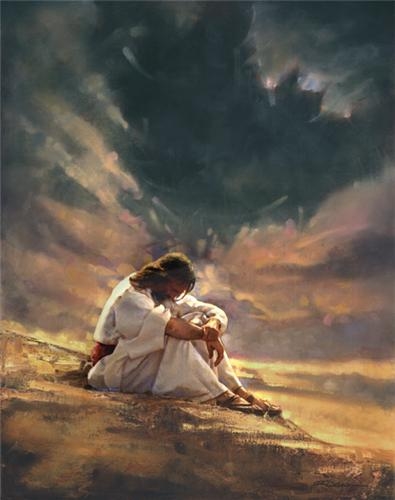
Jesus, full of the Holy Spirit, returned from the Jordan and was led around by the Spirit in the wilderness for forty days, being tempted by the devil. And He ate nothing during those days, and when they had ended, He became hungry. And the devil said to Him, “If You are the Son of God, tell this stone to become bread.” And Jesus answered him, “It is written, ‘Man shall not live on bread alone.’”

And he led Him up and showed Him all the kingdoms of the world in a moment of time. And the devil said to Him, “I will give You all this domain and its glory; for it has been handed over to me, and I give it to whomever I wish. Therefore if You worship before me, it shall all be Yours.” Jesus answered him, “It is written, ‘You shall worship the Lord your God and serve Him only.’”

And he led Him to Jerusalem and had Him stand on the pinnacle of the temple, and said to Him, “If You are the Son of God, throw Yourself down from here; for it is written,

‘He will command His angels concerning You to guard You,’

   and,

‘On their hands they will bear You up,
So that You will not strike Your foot against a stone.’”

And Jesus answered and said to him, “It is said, ‘You shall not put the Lord your God to the test.’”

When the devil had finished every temptation, he left Him until an opportune time.


Luke continues to paint a picture of Jesus' obedience. After humbling himself in the form of baptism, he is led into the wilderness for forty days of fasting, prayer, and temptation.  In the barren land populated only by the occasional robber or revolutionary, Jesus forgoes food, family, and friends to follow the Spirit's leading. With no physical resources, Jesus must rely on spiritual strength to combat Satan himself.

The first test was to fulfill his hunger. Surely the Son of God has a right to be well fed rather than starve. But Jesus answers that there are needs more substantial than bread, and God would supply what he really needed.

It is more amazing to me that Jesus did not turn the stones to bread than that he could. Growing up in a mainline Christian denomination I learned almost nothing about fasting. Fasting was giving up chocolate for Lent or fasting for the 30 hour famine to raise money for World hunger. The closest I came to fasting was an attempt to give up Mtn. Dew for 40 days as part of a youth group event, and I'm pretty sure I cheated a bit. In Jewish culture it was expected that there would be times of individual fasting as well as days of corporate fasting (the Day of Atonement prescribed in Leviticus as well as other days developed by Israel). It seems we kept the tradition of feasting but lost the discipline of fasting. In the past year I have attempted to learn to fast. At times I am successful, but at times I give up and eat dinner with everyone. It would be easier if fasting was a cultural occurrence and something learned from childhood, but we are still instructed in the New Testament to fast.

Fasting and prayer both take spiritual discipline. They focus us on God and open us to receive his blessings and instructions. Becoming more disciplined would obviously make a positive difference in our own lives. But it is a mystery how the spiritual discipline of believers affects things in the spiritual realm. Somehow our prayers help in the battle against unseen powers and principalities. And something about fasting along with praying can increase this.

The second test was to build his kingdom quickly - worship Satan and receive all the kingdoms of the world.This seems startling since God owns everything. But Satan has been given temporary power over the kingdoms of the world. The powers of darkness still push a "get rich quick" ethic in today's world. Cheating, lying, whatever it takes to get ahead is often encouraged instead of hard work and honesty that may or may not pay off. For Jesus, following God's way led to suffering, scorn, and eventually the cross. For you it may lead to suffering and scorn as well. Are you willing to do things God's way whether life brings feast or famine? One moment of worship for a lifetime of worldly power would seem a good trade off to many. Just think of all the good you could do if you were in control of everything! But one moment of worship would reveal something deeper - a hunger for personal power and self interest rather than reliance on God and his ultimate plan.

The third test was one to receive recognition. If Jesus hopped off the highest pinnacle of the temple in temple and floated to the ground with the help of angels, everyone would want to be in his fan club. It makes great marketing sense. But it wasn't God's way, and Jesus wanted true followers willing to follow him through suffering as well as easy times. Today Christians may rely on slick marketing campaigns to try to reach the masses, but the best evangelism may be living your life for God through thick and thin as you relate and share the gospel with those around you.

It is important to note that Satan quoted Scripture in this debate with Jesus. He is able to twist God's own words to serve his purposes. But Jesus has studied, memorized, and understood Scripture so that he was prepared when the battle came. Satan can prooftext, but Jesus knew the context. We cannot wait until we are in a time of trial to seek God's word on the subject. It is far better to spend time daily in God's Word to strengthen us today and prepare us for the future.


No temptation has overtaken you that is not common to man. God is faithful, and he will not let you be tempted beyond your ability, but with the temptation he will also provide the way of escape, that you may be able to endure it. - 1 Corinthians 10:13