Monday, January 21, 2013

Luke 2:1-7

Luke 2:7 - Then she gave birth to her firstborn Son, and she wrapped Him snugly in cloth and laid Him in a feeding trough—because there was no room for them in the inn. (full text here)

Zechariah's song in Luke 1 reveals a few of the Messianic expectations present at the time. The Jewish people expected the Saviour to overthrow the occupation, bring justice, restore righteousness, and reinstate the kingdom of David on earth. Chapter 2 reveals that things may not be as expected.  The night may have been silent, but I imagine Jesus cried like any baby as he felt the discomfort of the cold night air on newly born cheeks. The birth of Jesus was far from royal - born not in comfort but bound in cloths and laid in a feeding trough, surrounded not by the pampered upper class but by lowly shepherds, and snuggled closely by parents who were far from wealthy. But although this humble birth was unexpected, how amazing that the Messiah would suffer with his people even from birth.

From the start, our historian Luke reveals that the life and mission of the Messiah is not as was expected. Jesus is born in obscurity and humility, without fanfare or riches. He receives glory from angels and shepherds, but the people and the kingdoms of the world slept through the night unaware of how the world had changed. The Kingdom of the Messiah was from the beginning the opposite of the kingdoms of the world. He was born to rule not land, but hearts. He was born not to depose rulers, but to root out hidden sins. He was born not to point to Himself, but to point the way to the Father.

Jesus turns our religious presuppositions on their heads. Many Christians today say about their faith, "It's not a religion, it's a relationship." Rather than trying to be good to earn a better life or a place in heaven, we realize that by faith we are saved, through grace, not by ourselves but through the gift of God. Our "good works" are an outpouring of being plugged into the vine, the mere result of stumbling as we follow the footprints of the Good Shepherd. He calls us to do the unexpected, to live in a way that surprises the world. Contrary to the "me first" society prevalent in the world, we are to put "me last". As he made himself nothing, taking on the form of a servant, so we are to live justly, love mercy, and walk humbly with our God.

 
And whoever wants to be first among you must be a slave to all. For even the Son of Man came not to be served but to serve others and to give his life as a ransom for many."
- Mark 10:44-45

Friday, January 18, 2013

Luke 1:67-80

Luke 1:74-79
74 since we have been rescued
from our enemies’ clutches,
to serve Him without fear
75 in holiness and righteousness
in His presence all our days.
76 And child, you will be called
a prophet of the Most High,
for you will go before the Lord
to prepare His ways,
77 to give His people knowledge of salvation
through the forgiveness of their sins.
78 Because of our God’s merciful compassion,
the Dawn from on high will visit us
79 to shine on those who live in darkness
and the shadow of death,
to guide our feet into the way of peace. (full text here)


God must have seemed silent. Oppressed by a Roman occupation, in the midst of a culture growing more and more Hellenistic, as every Sabbath ancient scriptures were read that promised a hope and a future, many must have pondered how long it could be before God would act. Most thought a military answer would save them - a Messiah strong and mighty to save. Surely they would be saved to rule themselves, miraculously overthrowing the Romans and reestablishing the house of David.

But when the Holy Spirit rests on Zechariah, he prophesies about a much different scenario. Yes salvation was coming, but it would free God's people to serve the Lord. Rather than free to make military and financial gains, they were free to live in righteousness and holiness. The covenant of Abraham was not to overthrow enemies, but that through his descendant, Jesus, the world would be saved from the shackles of sin.

No prophet had been recorded for 400 years, but John was sent as a prophet of the most high God. He prepared the way for the Christ by brazenly calling people out for their sins and showing them tangible ways to repent. God's compassion wasn't about a comfortable life, it was about shining a light to lead us away from the path of sin that winds through the shadow of death. It was about peace, not prosperity. And today that same peace is available to us through God's merciful compassion! God may not act in the way we expect or desire, but he will always amaze us with his faithfulness and compassion when we walk his path.

Repent, for the kingdom of heaven is near.


The people walking in darkness have seen a great light; on those living in the land of the shadow of death a light has dawned.  - Isaiah 9:2

Thursday, January 17, 2013

Luke 1:57-66

Luke 1:63-64 - He asked for a writing tablet, and to everyone’s astonishment he wrote, “His name is John.” Immediately his mouth was opened and his tongue set free, and he began to speak, praising God.  (full text here)


Crowds always line up to see a new baby. In the days before mass entertainment, this may have been even more true. The community that had once whispered about what Zechariah and Elizabeth had done to merit God's disfavor now marvelled that a son had been mercifully born in their old age. After so many decades, the couple had an heir. Surely the firstborn and likely only child would be named after his father. But having many months to silently contemplate the words of the angel Gabriel, Zechariah instantly corrected his neighbors and family in obedience to the words spoken to him in the holy place of the temple.

Circumcision on the eighth day was a celebratory and holy affair - the sign of God's covenant with his people. The son had survived long enough to earn an official name and in a way his personhood. The age of the parents, the story of the angel, and even the naming of the child had tongues wagging all over the hill country. If God could move so strongly in the birth of this miracle child, surely great things were planned for his life.

The Hebrew name for John, Yôḥanan, means "Graced by Yahweh". John was graced not to serve as a priest like his father, but to survive in the wilderness bringing many to repentance and preparing the way for Jesus. Surely he grew up hearing that God had a great plan for his life. Surely his righteous parents steadfastly taught him the ways of God. And when the time came for him to fulfill his purpose he did so, even to death by beheading.

The gospel begins with ordinary people choosing to live lives of obedience to the father. What must happen before we are willing to believe and become what he would have us be? Need he strike us deaf and dumb for nine months like Zechariah or send us into nine months of seclusion like Elizabeth for us to take time to contemplate his will for our lives? Or can we find ways to unplug from our lives and plug in to God moving in the world around us? When God allows us to open our lips today, let our tongues be set free in praise of him!


In him you were also circumcised, in the putting off of the sinful nature, not with a circumcision done by the hands of men but with the circumcision done by Christ. For you were buried with Christ when you were baptized. And with him you were raised to new life because you trusted the mighty power of God, who raised Christ from the dead.
 - Colossians 2:11-12

Wednesday, January 16, 2013

Luke 1:39-56

Luke 1:45-50
45 And blessed is she who believed that there would be a fulfillment of what was spoken to her from the Lord.”
46 And Mary said,
“My soul magnifies the Lord,
47 and my spirit rejoices in God my Savior,
48 for he has looked on the humble estate of his servant.
For behold, from now on all generations will call me blessed;
49 for he who is mighty has done great things for me,
and holy is his name.
50 And his mercy is for those who fear him
from generation to generation. (full text here)
 

Pregnant women love to get together and talk about their pregnancies. Usually we compare morning sickness, stretch marks, baby gymnastics, and what I have never experienced - magical nesting energy. But this meeting between Mary and Elizabeth must have been amazing. Elizabeth's baby was a miracle in many ways and was to be a prophet in a land that had waited 400 years for a direct word from the Lord. The Holy Spirit filled Elizabeth as she cried out a blessing over Mary and her child. Even her preborn child lept in her womb at the appearance of the preborn baby Jesus. What an encouragement this must have been to Mary. Remember that as yet she did not know what Joseph's response would be to her situation. Even with her strong faith, surely she had some fears in her mind in the midst of her supernatural peace. Immediately after Elizabeth spoke, Mary sang praises to God for his faithful mercy that extends to his people from generation to generation.

Despite their age difference, Elizabeth must have been a trusted friend. Even though she hurried, Mary likely journeyed at least three days over the 80-100 miles from Nazareth to the hill country. Mary stayed with Elizabeth until the birth of John, likely helping her elderly relative with chores as she waddled through that tiring third trimester. (Can you imagine being a pregnant senior citizen??)

How wonderful that these two ladies were together to ponder the miraculous news surrounding their firstborn sons. They had each other on which to lean as they dealt with pregnancy symptoms, a mute husband, and qualms that must have been in Mary's mind about her unmarried state.

I am thankful in my own life that through easy and difficult times God has provided me with wonderful friends and family. As we go through our daily lives, let us seek opportunities to be an encouragement to others and in tune with the Holy Spirit to speak truths into their lives.

Let us not give up meeting together, as is the habit of some, but let us encourage one another--and all the more as you see the Day approaching.  - Hebrews 10:25

Tuesday, January 15, 2013

Luke 1:26-38

Luke 1:37-38  - For nothing will be impossible with God.” And Mary said, “Behold, I am the servant of the Lord; let it be to me according to your word.” And the angel departed from her. (full text here)


In the sixth month of Elizabeth's pregnancy, after her time of seclusion, the angel Gabriel appears to Mary. The story of the annunciation is  familiar, so much so that we can lose sight of how shocking it would have been. An angel appears, a sight that consistently frightens people throughout Scripture. He informs an unmarried Jewish girl that she will be with child, a fate punishable by death. This endangers her life and her engagement with Joseph (as legally binding as marriage but without living or sleeping together). She understandably responds with confusion. Luke uses the Greek dietarachthē - greatly agitated, thoroughly stirred up, confused, and perplexed. Gabriel explains that the power of God would accomplish this, and as confirmation shares the surprising news that her aged relative Elizabeth is already with child. Mary replies with one of the greatest statements of faith of all time.

How do we respond to the surprising turns of our life? Do we despair and lose hope when assailed by the storms of life? Do we muddle through confusion when circumstances don't play out the way we expected? Do we relegate God to Sunday mornings when life goes smoothly and only seek His will when things go awry?

What an example we find in Mary. She accepts that nothing is impossible with God and gives herself completely to his plan for her life - whatever comes. Can we humbly submit to God's will for our lives, believing that his plans are best even when confusing and perplexing? Do we truly believe that nothing is impossible for him? Let us follow Mary's example and trust that God can change us into the image bearers of Christ that we were created to be!


“I know that you can do all things, and that no purpose of yours can be thwarted." - Job 42:2

Monday, January 14, 2013

Luke 1:1-25

Luke 1:1-4 - Many have undertaken to compile a narrative about the events that have been fulfilled among us, just as the original eyewitnesses and servants of the word handed them down to us. It also seemed good to me, since I have carefully investigated everything from the very first, to write to you in an orderly sequence, most honorable Theophilus, so that you may know the certainty of the things about which you have been instructed. (full text here)


Occasionally there will be a buzz in the news about a "new gospel" found. Or perhaps the History Channel will run a special series on "the forbidden gospels". Books such as the Gospel of Thomas, Gospel of Phillip, and the Gospel of Judas make great plots for stories such as The Da Vinci Code, but they contradict each other as well as the canonical gospels and early church history. Pop culture references make these "gospels" seem to be equally on par with the book of Luke, but nothing could be farther from the truth. Some scholarly research would reveal that the gospel of Luke stands the test of time in historical accuracy when checked with other documents of the time period as well as being accepted by early believers and eyewitnesses who knew the true stories. Luke gives us an orderly account the life and ministry of Jesus, giving certainty to believers of the truth of the gospel. He has no need to innovate and sensationalize the story. He simply reports the facts. His sources are eyewitnesses and "servants of the word" who preserved the oral tradition of the apostles.

The passage continues with the story of John the Baptizer's conception. There was a couple, Zechariah and Elizabeth, who were upright and blameless in the eyes of God. Both were from the tribe of Levi - the tribe responsible for priestly duties. Despite their devotion to God they remained childless - seen in their time period as divine punishment. Five times a year Zechariah would have left home for the temple. During the three major Jewish festivals, all priestly divisions were on duty to serve the multitudes of pilgrims. Two other weeks a year he would also come to Jerusalem to help with the daily temple sacrifices and rituals.

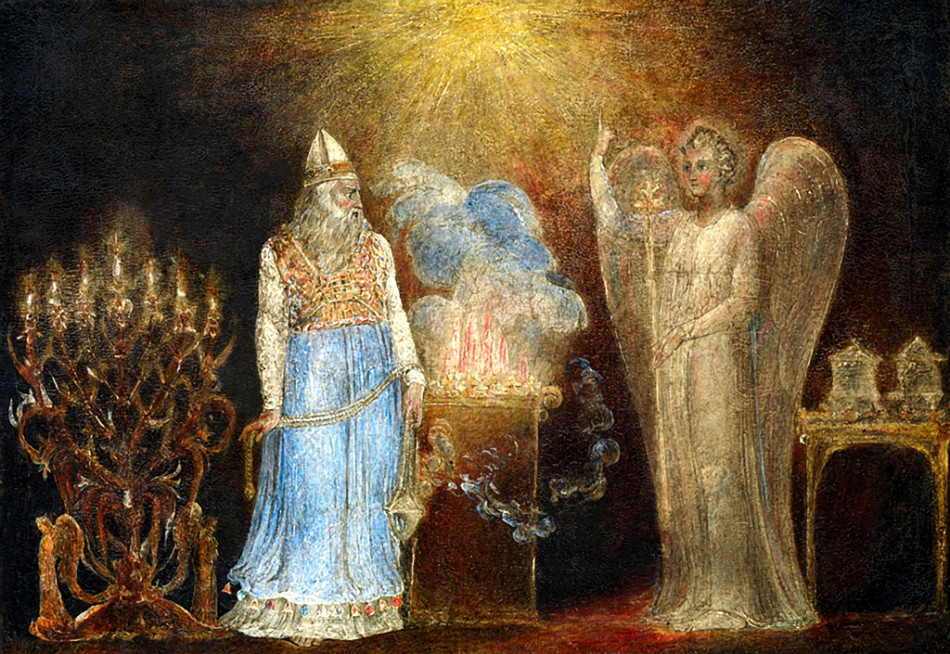
In the days of King Herod, a crazy ruler but amazing architect, Zechariah was ministering in the temple. He was chosen by lot to enter into the Holy Place and burn incense to the Lord in front of the veil to the Holy of Holies, a once in a lifetime opportunity. As priests and worshippers joined Zechariah in prayer from outside the building, the angel Gabriel suddenly appeared and announced to Zechariah that he and Elizabeth would have a son. Many would rejoice because of his birth, and he would call many to repentance. He was to be filled with the Holy Spirit and set apart in a similar manner to a Nazarite - a special commitment to the Lord. His mission would be to make ready a people prepared for the Lord.

Zechariah was overwhelmed and could not believe what he heard, despite the fact that he was talking to an angel. As a consequence he was struck dumb until the baby would be born. When Zechariah finally appeared to the waiting crowd, he could only make signs to indicate that he had seen a vision from the Lord. Despite his dumbness, he completed his week of service. His wife Elizabeth became pregnant and remained in seclusion for five months, secure in the knowledge that God had performed a miracle and removed her disgrace.

We often look at people like Zechariah in the Bible and shake our heads, wondering how they can be so daft. After all, an angel of the Lord would surely be convincing! But we often equally doubt truths spoken into our own lives. We ignore Scriptures that seem too difficult to follow. We close our ears to the calling of the Holy Spirit when He leads us toward paths that seem difficult. We doubt the goodness of God in the midst of the storms of life. We choose to follow pop culture rather than the truths of God.

God’s promises to us are no less binding than his promise of a son for Zechariah. He promises that we can participate in His divine nature, escaping the corruption of the world and our evil desires (2 Peter 1:4). He promises to supply all our needs through His riches in Christ Jesus (Philippians 4:19). He promises us perfect peace beyond anything the world can give (John 14:27). He promises us rest when we labor for Him (Matthew 11:28-29). He promises that He has a plan for our lives, one of a hope and a future (Jeremiah 29:11). But so many days we stumble through life, failing to live in the power of these guarantees. If God struck us dumb each time we disbelieved his promises, what a quiet bunch we would be!


Let us hold unswervingly to the hope we profess, for the one who made the promise is faithful.
- Hebrews 10:23

Sunday, January 13, 2013

Luke 1-8 background

This session of Bible study will cover Luke 1-8 - basically Jesus' birth and early ministry. The author of the book is Luke, a Gentile physician who traveled with Paul on parts of his missionary journeys (as indicated by the "we" passages in Acts 16, 20, & 27). Although not an apostle or early follower of Jesus, he received the traditions and stories of the gospel from apostles and other eyewitnesses. One of his main sources seems to be Mark.

Luke was a historian who sought to record events as they actually happened. Not surprisingly, as a physician he has a special interest in the healing miracles of Jesus. He wrote Luke and the second volume of his work, Acts, to "Theophilus" - which in Greek means "friend of God". Scholars debate whether this is a specific person's name, an honorary title, the name of a Jewish priest of the Sadducee branch, or a converted Roman official. Others believe the books were written to a larger Gentile audience - anyone who was a "friend of God". The book was probably written sometime around 60-75 AD.